A highschool kid's science award project has gone viral when he designed a screening tool for conditions such as Autism & ADHD
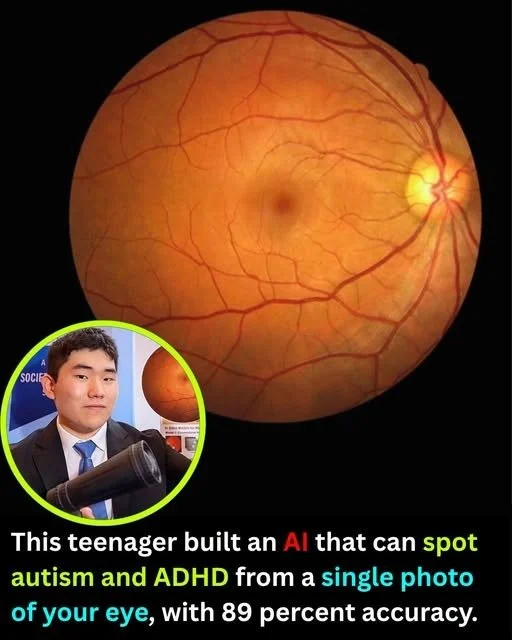
A 17-year-old just did something doctors have been trying to do for decades.
Edward Kang, a high school senior from Bergen County Academies in New Jersey, built an AI system that can screen for autism and ADHD using nothing but a single photo of the retina. Not months of behavioural evaluations. Not years of waiting lists. One image of the eye.
(For the orginal article, click here)
The science behind it is stranger than fiction, but it is real. The retina develops from the same tissue as the brain. It is technically part of the central nervous system, just sitting at the back of your eye where doctors can actually see it. Kang's theory: if autism and ADHD change how the brain develops, those changes might leave a fingerprint on the retina too.
He was right. His tool, called RetinaMind, hit 89 percent accuracy identifying patterns linked to these conditions. It does not just spit out a yes or no either. It generates a heat map showing exactly which parts of the retina influenced its decision, so the diagnosis is not a black box.
Kang did not stop at the AI. He went further and studied retinal cells in the lab, tracking down genes like ABCA4 that might explain why these differences show up in the eye in the first place.
The project won him second place and 175,000 dollars at the 2026 Regeneron Science Talent Search, the oldest and most prestigious science competition for high schoolers in the country.
It started three years ago when Kang stumbled on a research paper from the Chinese University of Hong Kong and thought the idea was too interesting to leave alone. He taught himself coding and machine learning to take it further.
RetinaMind is a research prototype tested on a dataset, not an approved clinical diagnostic tool. But this kind of screening could eventually shrink a diagnosis process that currently takes months or years down to a single eye scan.